This story is about CARPL.ai. InSnaps has no commercial relationship with them.
In short: CARPL.ai raised $10 million led by the IFC in July 2026 to run a platform that validates and monitors other companies' radiology AI. Its own FDA clearance is for image management, and carries no diagnostic performance claim.
- What it is
- A vendor-neutral platform for hospitals to discover, test, deploy and monitor third-party radiology AI algorithms
- Founder
- Dr Vidur Mahajan, a physician who previously ran the family radiology chain Mahajan Imaging; his father Dr Harsh Mahajan is a director
- Incorporated
- May 2018 in New Delhi, originally as Mahajan Imaging Research and Development. The CARPL product launched in 2021
- Funding
- $10 million Series A led by the IFC, part of the World Bank Group, announced 23 July 2026, with Stellaris Venture Partners. About $16 million raised in total
- Valuation
- Not disclosed
- The core problem
- More than 700 FDA-cleared radiology AI tools exist, each with its own integration and contract, and hospitals cannot evaluate or monitor them at scale
- US regulatory status
- FDA 510(k) K232891, cleared 27 March 2024, as a Medical Image Management and Processing System under 21 CFR 892.2050
- What that clearance covers
- Image storage, transmission, processing and viewing. It contains no diagnostic performance claim and validates no algorithm
- Financials
- Indian entity revenue of about Rs 17.74 crore in FY25, up 63%. Losses are not public
- Verification status
- Regulatory filings are primary-sourced; customer lists, marketplace counts and platform efficacy are company-stated and unaudited
There are now more than 700 FDA-cleared radiology AI tools. Each arrives with its own integration, its own viewer, its own contract and its own claims about accuracy. No hospital can evaluate that catalogue, and almost none can tell whether a tool that performed well in a vendor’s study will perform at all on their own patients, their own scanners, their own population.
CARPL.ai sells the layer that is supposed to answer that: discover an algorithm, test it on your own data, deploy it, then monitor it for drift. In July 2026 it raised $10 million led by the IFC, the World Bank Group’s private-sector arm, with Stellaris Venture Partners returning.
It is a genuinely useful idea, and the company has published more honestly about AI’s failure modes than most of the industry. Which makes it worth applying the same standard to the platform’s own claims — because the regulatory credential it markets does not mean what it appears to mean.
The company
CARPL was incorporated in May 2018 in New Delhi, originally as Mahajan Imaging Research and Development — the R&D arm of the family radiology chain. The CARPL product launched and took its own name in 2021, which is why press coverage dates the founding to 2021 while filings say 2018.
Dr Vidur Mahajan, a physician with an MBA, is founder and CEO; he previously ran Mahajan Imaging, taking it to around $20 million of revenue. His father, Dr Harsh Mahajan, a radiologist, is credited with conceiving CARPL while trying to validate AI tools inside the practice, and is a director. Ritu Mahajan is the third director of the Indian entity — a family-held board, which is worth noting in a company whose business runs on other people’s patient data.
The company says it employs 80 people and operates from Delhi NCR, the San Francisco Bay Area and Singapore. It has raised about $16 million in total; the valuation is not disclosed.
The regulatory claim, examined
CARPL holds FDA 510(k) clearance K232891, granted 27 March 2024. This is real and it is verifiable in the FDA’s own decision letter. It has been reported as a clearance that makes clinical AI deployment safer, and the company describes itself as the only AI marketplace with one.
Here is what it actually is. The device is cleared under 21 CFR 892.2050 — Medical Image Management and Processing System, Class II, product code LLZ. The indications for use describe “a web-based PACS and radiology workflow management device, used for viewing and assessing DICOM images,” enabling “the storage, transmission, processing, and visualization of images and data.” The predicate device is another company’s image-management system.
It contains no diagnostic performance claim whatsoever. It does not evaluate, validate or vouch for any AI model. Every algorithm hosted on the platform carries its own separate regulatory status. A 892.2050 clearance is the regulatory category for image plumbing — necessary, unglamorous, and silent on whether anything running through it is any good.
The clearance letter also carries restrictions that rarely make the marketing: lossy-compressed mammograms and digitised film must not be used for primary interpretation, FDA-specification monitors are required, and it is prescription-use only.
CARPL also announced a CE mark in October 2024, claiming to be the first enterprise imaging AI platform to hold one. We could not establish the notified body or the MDR classification — neither is disclosed anywhere we could find. We found no CDSCO registration in India and no UKCA marking, despite deployments in both jurisdictions.
The evidence question
CARPL’s research page lists 85 items dating from 2018, and the group publishes on exactly the things the industry prefers not to discuss: clinical explainability failure, bias estimation in chest X-ray classifiers, fairness in radiology AI, and a paper titled How to Lie with Statistics: Things To Keep in Mind While Evaluating a Deep Learning Claim. That is a real intellectual contribution and it is unusual for a vendor.
But two things need separating. Those studies validate third-party algorithms. We could not find a single peer-reviewed study measuring whether using CARPL improves diagnostic accuracy, turnaround time or patient outcomes. The platform’s own value proposition is, as far as we can establish, unvalidated in the literature.
The listing also does not distinguish peer-reviewed journal papers from conference abstracts and posters, and most entries expose no journal, sample size, sensitivity or specificity. The 2026 mammography and fracture-detection comparisons against human radiologists appear to be abstracts; we could not locate full texts.
Where the doubts sit
Analysts think the category may not survive as an independent one. AuntMinnie Europe reported in September 2025 that a major shake-up looms for the AI platform sector, quoting an analyst — unnamed, which we flag — saying the model “doesn’t really work because massive usage is required to justify the 30% platform fee,” that CARPL and its closest rival “are facing difficulties,” and that independent platforms “will be swallowed up by OEMs.”
The consolidation is already visible. DeepHealth acquired Gleamer; Sectra acquired Oxipit. And the real competitive threat is not another startup: GE HealthCare, Philips, Siemens Healthineers and Sectra are all embedding AI marketplaces into imaging IT that hospitals already buy from them. Signify Research’s read is that hospitals do not buy large portfolios of point tools, that algorithm accuracy has not converted into revenue, and that commercial traction concentrates in stroke triage and cardiac imaging — where reimbursement pathways exist. CARPL owns neither of those categories.
There is a disintermediation risk too. Several vendors listed on CARPL’s marketplace sell direct and have their own deployment stacks.
The human-factors risk runs the other way from the pitch. Research covered at RSNA found that incorrect AI advice shifts clinician decisions, and AuntMinnie Europe reported in 2026 that AI can mislead radiologists and make the error more persuasive. A universal viewer surfacing many models is exposed to that in proportion to how much it is used. CARPL’s own bias and fairness reporting is a genuine mitigation — but only if the customer actually runs the validation, which is optional.
Data governance deserves scrutiny. The business model involves testing third-party algorithms on customers’ patient imaging. India’s DPDP Act requires separate explicit consent for secondary use. The compliance assurances we found are self-asserted or come from the company’s own IT consultant; we saw no independent audit report. Combined with a three-member family board and the company’s origin inside a radiology chain, related-party and data-provenance questions are fair ones.
And there is no reimbursement. No CPT code, no NHS tariff, no ABDM pathway pays for a platform layer. Hospitals fund it from operating budgets, which is the hardest sale in health IT.
What we could not verify
Valuation, ownership or dilution — none disclosed.
Any loss figure, for any year. Indian-entity revenue is around Rs 17.74 crore in FY25, up 63% from about Rs 10.9 crore, per filings aggregators. EBITDA and net loss are paywalled. Revenue also sits partly in the US entity, so the Indian filing likely understates the group.
The marketplace counts move in the wrong direction. Company messaging has said 100+ apps and 50+ vendors in February 2024, then 80 apps and 40 vendors in October 2024, then 150+, then 300+ apps and 100+ partners in July 2026. A count that falls and then quadruples needs an explanation.
Customer claims are unaudited — “four of the world’s top five private radiology groups,” around 30 hospitals, and named governments including Brazil, Singapore, Spain and the UAE. Government contracts also mean lumpy, tender-driven revenue.
The CE mark’s class and notified body, and whether the 2024 $6 million round was legally a seed or a Series A — outlets contradict each other.
Whether the “30% platform fee” applies to CARPL. It is a sector-level analyst figure, not a confirmed take rate.
Headcount: 34, 64 and 80 appear in different sources.
Why this is on our desk
Because a company whose product is the auditing of other people’s claims is the right place to test how claims get made in this industry — and because the gap here is instructive rather than scandalous.
CARPL is doing something the field needs, and publishing research that undercuts its own sector’s marketing. It is also marketing an image-management clearance as a clinical-safety credential, and has no published evidence that its platform improves any clinical outcome. Both things are true. In a category where hospitals are being asked to trust software with diagnoses, the distinction between “cleared to move images” and “shown to help patients” is the whole point.
FAQ
What does CARPL.ai do?
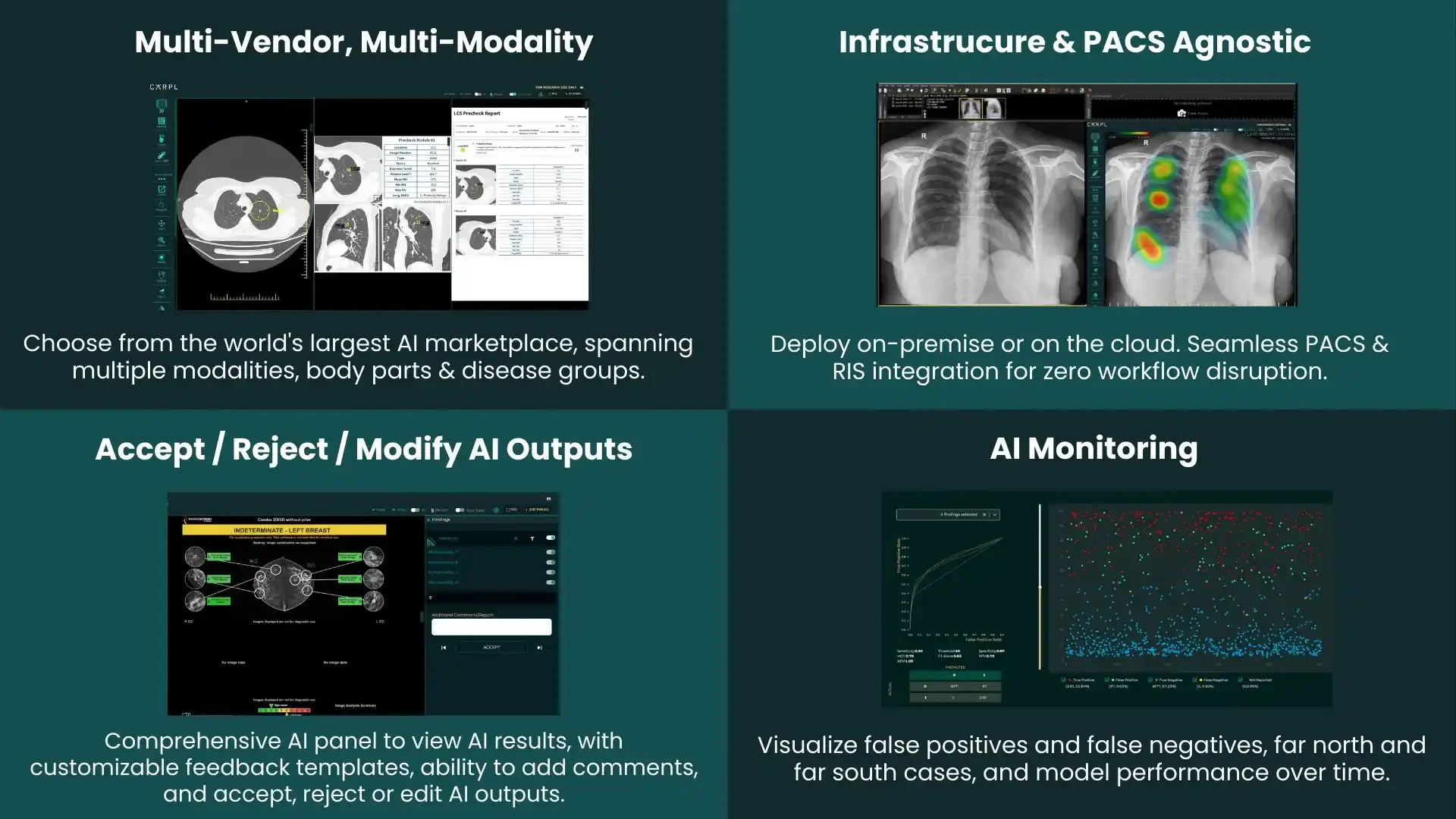
It is a vendor-neutral platform that lets hospitals discover radiology AI tools, test them on their own imaging data before buying, deploy them across PACS systems, and monitor their performance for drift. It includes a universal viewer where radiologists accept, reject or edit AI output.
Is CARPL FDA approved?
It has FDA 510(k) clearance, K232891, granted in March 2024 — which is clearance, not approval, and specifically as a Medical Image Management and Processing System under 21 CFR 892.2050. That covers storing, transmitting, processing and viewing images. It carries no diagnostic performance claim and does not validate any AI algorithm; each hosted algorithm has its own separate regulatory status.
Who funded CARPL and how much?
A $10 million Series A led by the IFC, part of the World Bank Group, announced on 23 July 2026, with existing investor Stellaris Venture Partners. An earlier $6 million round closed in 2024. Total disclosed funding is about $16 million; the valuation has not been disclosed.
Is there evidence CARPL improves patient outcomes?
Not that we could find. The company publishes prolifically on validating and stress-testing third-party algorithms, including their biases and failure modes, but we located no peer-reviewed study measuring whether using the CARPL platform itself improves diagnostic accuracy, turnaround or outcomes.
Who competes with CARPL?
Directly, deepc, Blackford Analysis (owned by Bayer), Aidoc’s aiOS, Ferrum Health, Incepto and Microsoft’s Precision Imaging Network. The bigger threat is bundling by imaging OEMs — GE HealthCare, Philips, Siemens Healthineers, Sectra and RadNet’s DeepHealth — who already sell hospitals their imaging IT.
Who pays for it?
Hospitals, radiology groups and national health systems, out of operating budgets. There is no reimbursement code for a platform layer in any major market, which is a structural constraint on the business.
Sources
Checked on 23 August 2026. The regulatory position is taken from the FDA’s own decision letter. Customer counts, marketplace scale and platform efficacy are company-stated and unaudited.
- CARPL.ai — the funding announcement: <https://carpl.ai/news/carplai-raises-10mn-led-by-ifc-to-accelerate-healthcare-ai-adoption-globally>
- FDA 510(k) K232891 decision letter — device classification, indications for use and restrictions: <https://www.accessdata.fda.gov/cdrh_docs/pdf23/K232891.pdf>
- AuntMinnie — coverage of the 510(k) clearance: <https://www.auntminnie.com/imaging-informatics/enterprise-imaging/article/15676481/carplai-fda-grants-carplai-510k-for-enterprise-imaging-ai-platform>
- AuntMinnie Europe — the analyst view that independent AI platforms may not survive: <https://www.auntminnieeurope.com/imaging-informatics/artificial-intelligence/article/15754848/major-shakeup-looms-for-ai-platform-sector>
- Inc42 — the round and marketplace scale: <https://inc42.com/buzz/carpl-ai-bags-10-mn-to-scale-its-ai-medical-imaging-marketplace/>
- CARPL research page — the 85 listed publications: <https://carpl.ai/research>
- Signify Research — where imaging AI actually earns revenue, and why portfolios do not sell: <https://www.signifyresearch.net/insights/what-makes-a-platform-matter-strategic-value-in-imaging-ai-2/>
- TheCompanyCheck — Indian entity revenue and filing details: <https://www.thecompanycheck.com/company/carplai-private-limited/U73100DL2018PTC333492>
CARPL.ai was not contacted before publication and has not commented. If the company will name its CE notified body, publish a study of the platform’s own clinical effect, or reconcile its marketplace counts, we will add them to this page.