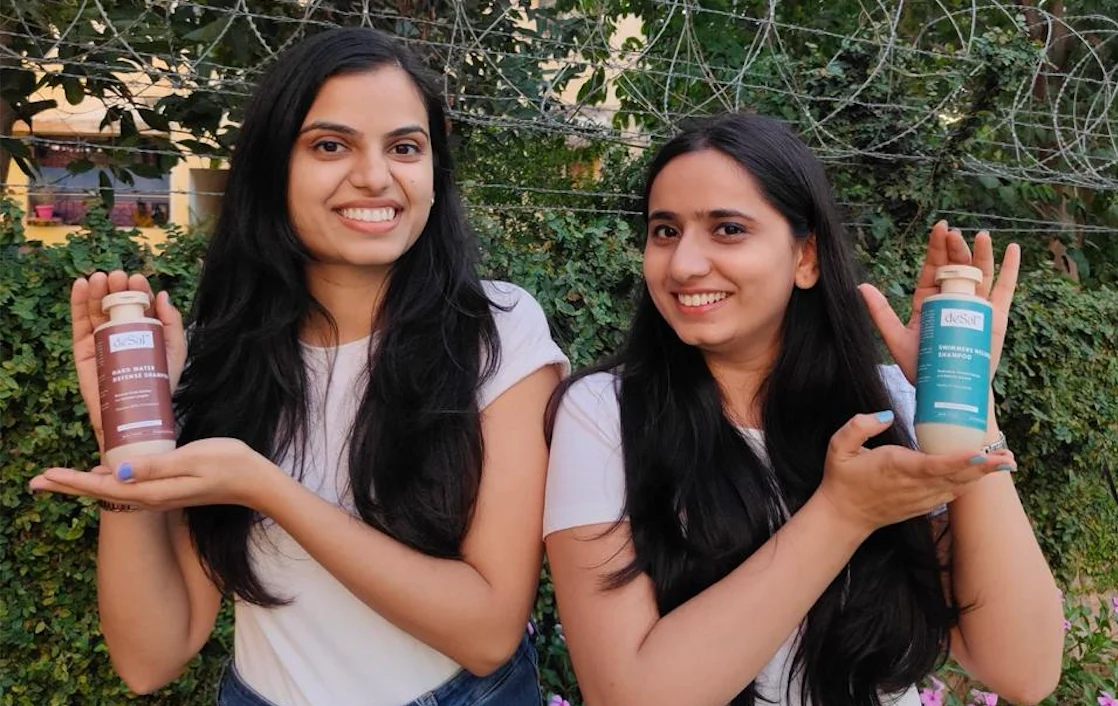
This story is about deSal. InSnaps has no commercial relationship with them.
In short: deSal's Hard Water Defense and Swimmers Wellness shampoos target mineral deposition and chlorine oxidation respectively. Both share an identical base, and in both the headline active sits below the preservative on the ingredient list.
- The two products
- Hard Water Defense Shampoo for mineral buildup and Swimmers Wellness Shampoo for chlorine damage, both 220 ml
- Prices
- Hard Water Defense at Rs 764 (MRP Rs 899); Swimmers Wellness at Rs 806 (MRP Rs 949)
- Hard water mechanism
- Calcium and magnesium ions deposit on the hair shaft as a film; deSal calls it "a coating problem"
- Hard water active
- Disodium EDTA, a chelating agent that binds metal ions so they rinse away. Listed 15th of 19 ingredients
- Chlorine mechanism
- Chlorine oxidises cystine bonds in keratin into cysteic acid, weakening the fibre from inside
- Chlorine active
- Sodium ascorbyl phosphate, a stable vitamin C derivative that reduces chlorine to chloride. Listed 13th of 22
- Shared base
- The first seven ingredients of both products are identical
- Stated pH
- 5.45 for Hard Water Defense, inside the mildly acidic range usually considered appropriate for hair
- Dosing
- Indexed to water hardness, not hair type: once weekly at 150-300 ppm, twice at 300-500 ppm, three times above 500 ppm
- What deSal says it cannot do
- Its own writing says hard water is "not shown to cause hair fall" and that neutralising chlorine "doesn't reverse bonds already broken"
- Verification status
- Ingredient lists and prices are published; clinical results sit behind a shared-drive link with no sample sizes, and two of the market statistics on the site trace to no source at all
- Independent evidence
- Mineral deposition on hair is well demonstrated; breakage is contested across four small studies; hard water causing shedding has no support
Most shampoo marketing describes a feeling. deSal’s describes a reaction, which is unusual enough to be worth checking.
The Bengaluru brand — founded by Ankita and Akanksha, both IIT Roorkee engineering graduates — sells exactly two products. Hard Water Defense Shampoo (220 ml, listed at Rs 764 against an Rs 899 MRP) and Swimmers Wellness Shampoo (220 ml, Rs 806 against Rs 949). Each names a specific chemical problem and a specific molecule aimed at it.
So we read both ingredient lists, and then read what the company itself says the products cannot do. Both are more interesting than the marketing.
Problem one: hard water leaves a film
Hard water is water carrying dissolved calcium and magnesium. When it runs over hair, those ions deposit on the outside of the shaft and accumulate. deSal’s own framing is precise and, notably, modest: it calls this ”a coating problem.”
That distinction matters, because a coating behaves differently from damage, and it is also where the marketing in this whole category outruns the evidence. Three separate claims get collapsed into one, and they are not equally supported:
Deposition is well established. Scanning electron microscopy with elemental analysis found mean calcium deposition of 0.804% on hair treated in hard water against 0.26% in distilled water, and magnesium 0.34% against 0.078% (Srinivasan et al., International Journal of Dermatology, 2016). Separate work using ICP-AES confirmed uptake happens into the fibre, not merely onto it, and that it stiffens the fibre (Evans et al., International Journal of Cosmetic Science, 2011).
Breakage is contested. Luqman et al. (International Journal of Trichology, 2018) found hard water reduced hair tensile strength significantly (234.16 against a 255.49 control, p=0.001). But an earlier study in the same journal found nothing: Srinivasan et al. (2013) reported tensile strength of 105.28 against 103.66, p=0.858, and concluded that “hard water does not interfere with the tensile strength and elasticity of hair.” A 2017 SEM study likewise found significantly higher magnesium deposits but no significant difference in structural surface damage, and calcium deposition that did not reach significance. Two studies for, two against, all small and all soaking strands rather than washing heads. This is a thin, split literature, not a settled finding.
Shedding has no evidence at all. Nothing in the indexed literature links hard water to hair fall from the follicle.
One finding cuts directly against the standard pitch, and no brand quotes it: Evans and Marsh measured hardness metals producing a reduction in combing forces, not an increase. So “hard water makes hair tangly” — a line this category leans on constantly — is not supported by the primary work.
What is not in dispute is why ordinary shampoo does not shift the deposits: surfactants are built to lift oil and dirt, not to pull ionically bound metal off keratin.
The answer the brand reaches for is chelation. A chelating agent grabs a metal ion and holds it in solution so it rinses out instead of redepositing. That is a real and well-understood mechanism, and it is the line deSal draws between itself and a clarifying shampoo — clarifying strips surface residue, chelating sequesters ions.
The chelator is disodium EDTA — and here the independent literature raises a problem specific to this use.
The best peer-reviewed work on chelants in hair is about copper, not calcium. In that work, Naqvi et al. (International Journal of Cosmetic Science, 2013) compared EDTA against EDDS and found that only EDDS still worked when both calcium and copper ions were present — EDTA was competitively out-competed by the ambient calcium. Which is an awkward result for a shampoo whose entire purpose is to be used in calcium-rich water: the chelant is the one that saturates first.
There is also no published controlled trial showing that any consumer chelating shampoo removes a quantified mass of calcium from hair, or that doing so improves a clinical outcome. The efficacy case is extrapolated from colour-chemistry research, not demonstrated in a shampoo.
To be fair to deSal, this is a criticism of the whole chelating-shampoo category rather than of this brand. And the mechanistic distinction it draws — chelating sequesters ions, clarifying emulsifies oils — is correct, and worth correcting people on.
Problem two: chlorine breaks bonds
The Swimmers product addresses something mechanically different, and deSal describes it correctly: chlorine ”oxidises cystine bonds into cysteic acid.”
Cystine bonds are the disulphide cross-links that give keratin its strength. Oxidising them to cysteic acid is not a coating on the outside — it is structural loss inside the fibre, which is why swimmers’ hair turns brittle and porous rather than merely dull. The stated countermeasure is sodium ascorbyl phosphate, a stable vitamin C derivative, which chemically reduces residual chlorine to chloride so it stops oxidising. Alongside it sits niacinamide.
Here the company is blunt about the limit: neutralising chlorine ”stops further oxidation and supports the fibre going forward,” but ”it doesn’t reverse bonds already broken.” That is the correct thing to say, and most brands would not say it.
Two things in this product’s claims do not survive contact with the literature.
The green tint is copper, not chlorine. deSal lists protection against “green or brassy tones” among the benefits of neutralising chlorine. But the cause of green swimmers’ hair has been documented since 1977, and it is copper — from copper-based pool algicides or from plumbing — binding to disulphide groups in keratin (Lampe et al., JAMA, 1977; Nordlund et al., Archives of Dermatology, 1977, which recorded green hair in two women from copper-rich tap water with no pool involved). Immersion work found hair in copper without chlorine turned green, while hair in chlorine without copper did not. Chlorine’s role is as an enabler: by cleaving disulphide bonds it increases how much copper the fibre can bind. So a vitamin C derivative that reduces free chlorine does not address the chromophore — removing bound copper needs a chelant. deSal’s formula does contain EDTA, so the product may well help with green tint; but not by the mechanism the page gives.
The niacinamide claim is the weakest thing on either label. deSal says niacinamide “rebuilds keratin protein structure.” The best available evidence points the other way: Oblong et al. (International Journal of Cosmetic Science, 2020) reviewed the literature and concluded topical niacinamide does not stimulate hair growth, and ex-vivo work in the Journal of Investigative Dermatology found 1% and 4% nicotinamide increased catagen-like follicles in cultured human scalp. Niacinamide has good evidence behind it for skin barrier and inflammation; for rebuilding hair keratin it has none.
What chlorine does do, beyond oxidising cystine, is strip 18-MEA — the covalently bound lipid layer on the cuticle. That loss is what actually leaves post-swim hair rough and high-friction.
What the labels actually show
Now the part the marketing does not lead with. Both full ingredient lists are published on the product pages, so they can be read.
| Hard Water Defense | Swimmers Wellness | |
|---|---|---|
| Ingredients listed | 19 | 22 |
| First seven ingredients | identical | identical |
| Headline active | Disodium EDTA — #15 of 19 | Sodium ascorbyl phosphate — #13 of 22 |
| Preservative (phenoxyethanol) | #12 | #10 |
| Also contains EDTA | — | yes, #17 |
Two things follow.
The two products are the same shampoo with different additions. Water, caprylyl/capryl glucoside, sodium cocoyl isethionate, disodium laureth sulfosuccinate, cocamidopropyl betaine, polyquaternium-7 and sodium PCA — the first seven entries — are identical in both. That is a mild, sulphate-free surfactant base, a sensible choice and consistent with the SLS-free claim. The Swimmers formula then adds niacinamide, sodium ascorbyl phosphate, vitamin E, spirulina and polysorbate 20.
In both products, the named active is listed after the preservative. Under INCI convention, ingredients above 1% appear in descending order of concentration; below 1%, a manufacturer may list them in any order. Phenoxyethanol is capped at 1% and typically used near that ceiling. So an ingredient appearing after phenoxyethanol is, in practical terms, at or below roughly 1% — and in Hard Water Defense, disodium EDTA sits three places after it.
That is not evidence of anything improper. Disodium EDTA at a fraction of a percent is one of the most common ingredients in cosmetics, used precisely because it sequesters metal ions: it stabilises formulas and helps surfactants lather in hard water. Which is exactly the question worth putting to a brand whose whole thesis is chelation — is the EDTA here at a materially higher level than the EDTA already sitting in an ordinary supermarket shampoo, and if so, what level? deSal publishes the ingredient but not the percentage, so a reader cannot tell.
Niacinamide is worth noting: it sits at #8 in the Swimmers formula, ahead of the preservative, so plausibly present at a more substantial level than the vitamin C derivative it is paired with.
The dosing table is the smartest thing here
One detail separates this from a supermarket “for hard water” claim. The usage instructions are indexed to your water, not your hair:
- 150-300 ppm — once a week
- 300-500 ppm — up to twice a week
- above 500 ppm — up to three times a week
The formula’s stated pH is 5.45, which is a real point in its favour. The reference work here — Gavazzoni Dias et al., International Journal of Trichology, 2014 — recommends shampoo at pH 5.5 or below, and found that of 123 shampoos surveyed, only 38% met it. Above the hair’s isoelectric point of 3.67, the fibre surface carries increasing negative charge, which raises friction and cuticle lifting during washing and combing; alkaline pH also swells the fibre. Note that the paper is a review with a pH survey rather than a trial, and its authors say plainly that no standardised value for final shampoo pH exists.
But the dosing table only works if the buyer knows their own TDS reading, which almost nobody does. That single dependency explains the rest of deSal’s operation — a “Know Your TDS” page, and roughly fifty articles telling readers what the water is like in individual neighbourhoods, from Whitefield and Sarjapur to Gachibowli and the DLF phases of Gurugram. The content is not decoration around the product. It is what makes the dosing instruction usable.
One argument of theirs that holds up
Several of deSal’s articles attack the shower-filter category, arguing that a filter cannot fix hard water. On the mechanism, they are right.
Softening means removing dissolved calcium and magnesium, which requires ion exchange over a resin bed regenerated with brine — a plumbed appliance, not an inline cartridge. The media in shower filters do something else: KDF converts free chlorine to chloride by electron transfer, activated carbon adsorbs chlorine and organics, and ascorbic-acid cartridges reduce free chlorine. Hardness ions pass straight through all three. The only standard covering these products, NSF/ANSI 177, certifies material safety, structural integrity, flow rate and a minimum 50% reduction in free available chlorine — it says nothing about hardness, and nothing about any hair outcome.
So a shower filter’s honest job is chlorine, not hardness. Worth noting the symmetry, though: “filters can’t fix hard water” is also the water-softener industry’s line, and it does not follow that a chelating shampoo can fix it either. There is no in-hair efficacy trial for either product.
Two places the story does not line up
The product page and the brand’s own writing disagree about hair fall. deSal’s article comparing damage types states plainly that hard water is ”not shown to cause hair fall.” The Hard Water Defense product page lists, among its claims, ”Reduces Hair Breakage and Excessive Shedding.” Breakage and shedding are different events — one is a fibre snapping, the other a follicle releasing — and the brand elsewhere makes exactly that distinction. Hair fall is also the highest-volume search term in this category, which is presumably the pressure that produced the second sentence.
”Swimmers” is not the product for sea swimming. The Swimmers formula targets chlorine specifically. For salt water, which deSal describes as osmotic dehydration — the salt gradient pulling moisture out of the strand — it points readers back to Hard Water Defense, for its hyaluronic acid, panthenol and argan oil. Defensible chemistry, confusing shelf naming: the bottle labelled for swimmers is the wrong one if you swim in the sea.
What we could not verify
The clinical results are not really published. Both pages say “in-vivo tested” and link to results through a shared Google Drive link. No sample size, no protocol, no lab named, no control described. In-vivo testing on a cosmetic can mean a rigorous instrumented study or twenty volunteers answering a questionnaire, and nothing on the site distinguishes the two.
The market statistics are not merely uncited — two of them appear to have no basis at all. “85% of Indian Homes Have Hard Water” is almost certainly a laundered American figure: ”85% of US homes have hard water” is a long-circulated, USGS-derived plumbing-industry number, and the India version shows up only on water-softener retail sites with no citation. We could find no Indian census, NSSO, Jal Shakti, CGWB or BIS publication containing an 85% household figure — and since no national household-level hardness survey exists, the number could not be produced even in principle. “388M+ Indians face hard water” traces to nothing either; it is close to figures for Indians lacking access to safe water, which is a different metric entirely. “61% Swimmers face hair discoloration” is likewise unsourced.
The underlying problem is real, which makes the invented precision unnecessary. India’s groundwater is predominantly calcium-bicarbonate type, and regional peer-reviewed surveys find anywhere from 15% to 89% of samples exceeding the BIS hardness limit of 200 mg/L depending on where you sample — 81% in Bagpat, 89% in Prayagraj, 48% in Valliyur, 15% in Nainital. The Central Ground Water Board’s 2024 national report, covering 15,259 monitoring locations, does not publish a national hardness exceedance percentage at all. deSal could have cited any of the regional studies. It cited a number that does not exist.
No percentage for any active is disclosed, which is the single number that would settle whether these are chelating shampoos or ordinary shampoos with a chelating story.
The traction is small. On the company’s own storefront, Hard Water Defense shows 31 reviews and Swimmers Wellness 9. “Trusted by 500+ families” and “100+ orders in 30 days” are the company’s claims. We found no press coverage, no funding announcement and no named testing partner.
Why this is on our desk
Because a brand that describes a mechanism instead of a mood invites the one thing most consumer marketing forecloses: you can check it.
Read against its own ingredient lists, deSal comes out better than expected on chemistry and framing. The mechanisms are right, the pH is sensible, the surfactant base is mild, and the company volunteers limits most competitors bury. It comes out weaker on the thing that actually decides efficacy — dose — which it does not publish.
FAQ
What is the difference between deSal’s two shampoos?
Hard Water Defense targets mineral buildup using disodium EDTA, a chelating agent that binds calcium and magnesium so they rinse away. Swimmers Wellness targets chlorine damage using sodium ascorbyl phosphate, a stable vitamin C derivative that reduces chlorine to chloride, plus niacinamide. The first seven ingredients of both are identical; the difference is what is added on top.
Is a chelating shampoo different from a clarifying shampoo?
Yes, and mechanically so. A clarifying shampoo uses stronger surfactants to emulsify surface oil and residue; surfactants have no meaningful affinity for metal ions. A chelating agent binds those ions — the calcium and magnesium hard water deposits — into a water-soluble complex that rinses out. Two caveats: no published trial shows a consumer chelating shampoo removing a quantified mass of calcium from hair, and peer-reviewed work found EDTA specifically gets out-competed by ambient calcium, which is the very condition it is sold for.
Does chlorine turn swimmers’ hair green?
No. The green tint is caused by copper — from pool algicides or plumbing — binding to disulphide groups in keratin, documented since 1977. Chlorine contributes by cleaving those bonds and so increasing copper uptake, but it is not the chromophore. Removing bound copper requires a chelating agent, not a chlorine neutraliser.
Does hard water cause hair fall?
No — there is no evidence in the indexed literature linking hard water to shedding from the follicle. Mineral deposition on and into the hair shaft is well demonstrated; whether it causes measurable breakage is genuinely contested, with two small studies finding an effect on tensile strength and two finding none. deSal’s own writing says hard water is “not shown to cause hair fall,” though its Hard Water Defense product page separately claims to reduce “Excessive Shedding” — a contradiction between the two.
Which deSal shampoo should a sea swimmer use?
Not the Swimmers one, on deSal’s own account. That formula is built for chlorine. For salt water, which the company describes as drawing moisture out of the hair, it recommends Hard Water Defense for its humectants and oils.
How often is deSal’s hard water shampoo meant to be used?
By water hardness rather than hair type: once a week at 150-300 ppm TDS, up to twice a week at 300-500 ppm, and up to three times a week above 500 ppm.
What is the pH of deSal’s shampoo?
The company states 5.45 for Hard Water Defense, which falls inside the mildly acidic range generally regarded as appropriate for hair and scalp. The Swimmers product page does not state a pH.
Sources
All facts were taken from deSal’s own published pages, including its full INCI ingredient lists, and checked on 22 August 2026. The ingredient-position observations are our own reading of those lists. Where a figure is the company’s claim, the article says so.
- deSal, Hard Water Defense Shampoo — full ingredient list, claims, stated pH, TDS-indexed dosing, review count: <https://desal.in/products/hard-water-defense-shampoo>
- deSal, Swimmers Wellness Shampoo — full ingredient list, claims, usage guidance, review count: <https://desal.in/products/swimmers-wellness-shampoo>
- deSal, “Hard Water vs Chlorine vs Salt Water” — the company’s own account of the three mechanisms and what each product does not do: <https://desal.in/blogs/news/hard-water-vs-chlorine-vs-salt-water-hair-damage>
- deSal, “The Chemistry of Hard Water Hair Damage” — its explanation of disodium EDTA and chelation: <https://desal.in/blogs/news/the-chemistry-of-hard-water-hair-damage-how-disodium-edta-and-chelation-actually-work>
- deSal homepage — pricing and market claims: <https://desal.in/>
- deSal, “Our Story” — founders and origin: <https://desal.in/pages/our-story>
Independent literature cited above
- Srinivasan G, et al., “Scanning electron microscopy of hair treated in hard water,” Int J Dermatol 2016 — calcium and magnesium deposition figures: <https://pubmed.ncbi.nlm.nih.gov/26711619/>
- Srinivasan G, et al., “Effects of Hard Water on Hair,” Int J Trichology 2013 — the null result on tensile strength: <https://pmc.ncbi.nlm.nih.gov/articles/PMC3927171/>
- Luqman MW, et al., Int J Trichology 2018 — the positive result on tensile strength: <https://pubmed.ncbi.nlm.nih.gov/30034190/>
- Naqvi KR, et al., “The role of chelants in controlling Cu(II)-induced radical chemistry,” Int J Cosmet Sci 2013 — EDTA out-competed by calcium: <https://onlinelibrary.wiley.com/doi/10.1111/j.1468-2494.2012.00755.x>
- Gavazzoni Dias MFR, et al., “The Shampoo pH can Affect the Hair: Myth or Reality?” Int J Trichology 2014 — isoelectric point and pH guidance: <https://pmc.ncbi.nlm.nih.gov/articles/PMC4158629/>
- Lampe RM, et al., JAMA 1977 and Nordlund JJ, et al., Arch Dermatol 1977 — green hair caused by copper: <https://jamanetwork.com/journals/jamadermatology/fullarticle/538026>
- Oblong JE, et al., “Topical niacinamide does not stimulate hair growth,” Int J Cosmet Sci 2020: <https://pubmed.ncbi.nlm.nih.gov/31955438/>
- NSF/ANSI 177, the shower-filter standard — scope limited to chlorine reduction and material safety: <https://www.nsf.org/water-systems/water-filtration/nsf-ansi-177-shower-filter-certification>
- Central Ground Water Board, Annual Ground Water Quality Report 2024 — 15,259 monitoring locations, no national hardness percentage published: <https://cgwb.gov.in/en/annual-ground-water-quality-report-2024>
deSal was not contacted before publication and has not commented. If the company will state the concentration of disodium EDTA and sodium ascorbyl phosphate in each formula, or publish the in-vivo protocol and sample size, we will add both to this page.