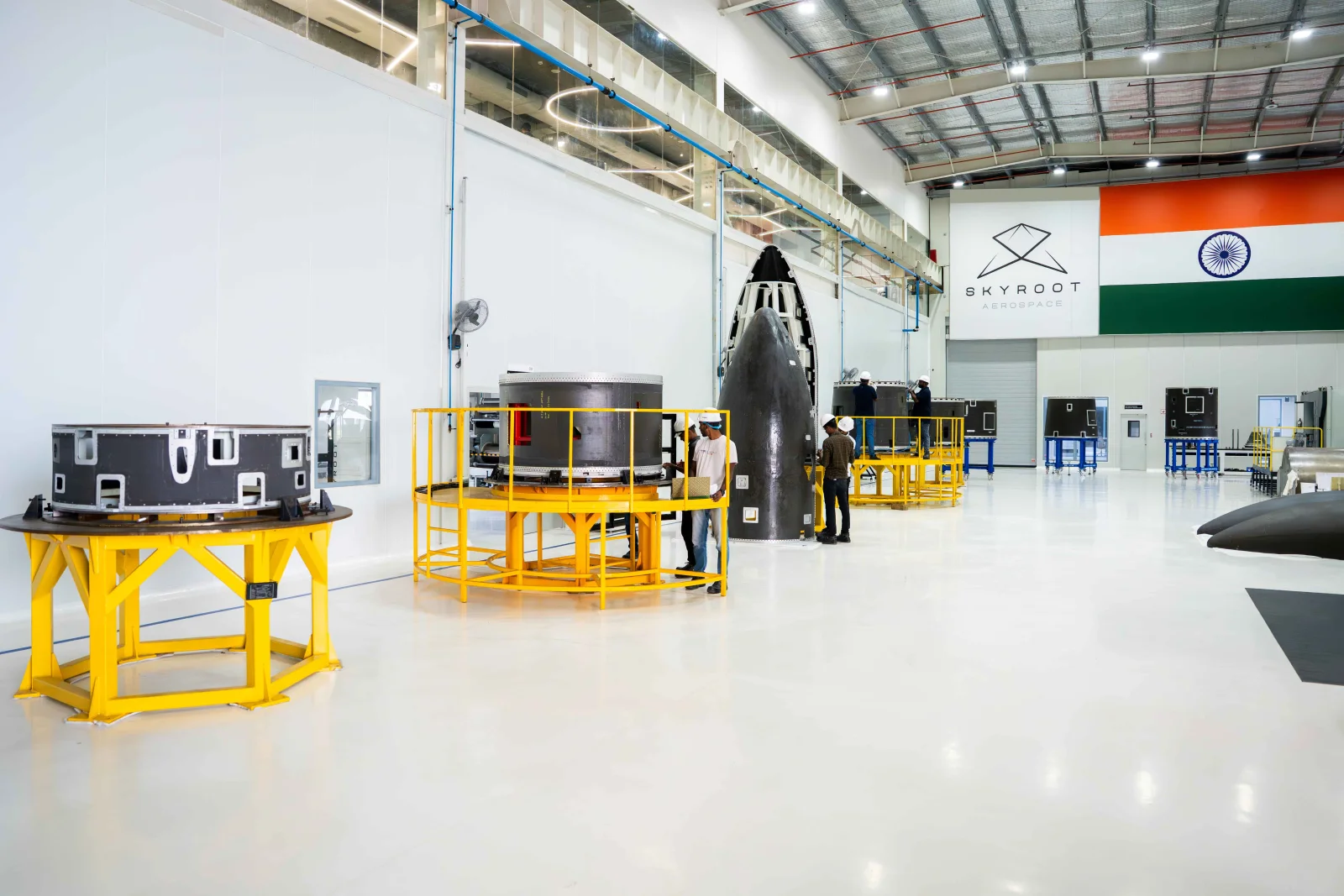
This story is about Skyroot Aerospace. InSnaps has no commercial relationship with them.
In short: Vikram-1 put payloads into a 450 km orbit on 18 July 2026, making Skyroot the first private Indian company to reach orbit. It did so on FY25 revenue of Rs 32 crore against a Rs 99.7 crore loss.
- What it is
- An Indian private launch vehicle company building the Vikram family of small satellite rockets
- Founders
- Pawan Kumar Chandana (CEO) and Naga Bharath Daka (COO), both former ISRO engineers
- Founded
- 2018, headquartered in Hyderabad
- The milestone
- Vikram-1 reached a roughly 450 km low Earth orbit on 18 July 2026, from ISRO's First Launch Pad at Sriharikota, succeeding on its first attempt
- Earlier flight
- Vikram-S, November 2022, a sub-orbital test to an apogee of 89.5 km, below the 100 km Karman line
- Vehicle
- Four stages, three solid plus one liquid orbital-adjust stage, about 24 m tall, rated up to 350 kg to a 500 km orbit
- Series C
- $60 million in May 2026 at a $1.1 billion valuation, making it India's first spacetech unicorn
- Total raised
- Roughly $150-160 million, depending on whether venture debt is counted
- Reported new round
- About $200 million at a roughly $2 billion valuation, reported in early August 2026 and not confirmed by the company
- FY25 financials
- Revenue of Rs 32 crore against a net loss of Rs 99.7 crore
- Verification status
- The launch and funding are well documented; the order book, launch cadence targets and per-kilogram pricing are company or analyst figures with no independent audit
At 12:05 on 18 July 2026, after a thirty-five minute hold, a four-stage rocket built by a company founded eight years earlier lifted off from Sriharikota and put its payloads into a roughly 450 kilometre orbit. Vikram-1 worked on its first attempt, which is not how this usually goes.
That makes Skyroot Aerospace the first private Indian company to reach orbit. It is a genuine engineering achievement and it has been reported as such. The more interesting question is the one underneath it: whether reaching orbit and having a launch business are the same thing. The recent history of small rockets says they are not.
The company
Skyroot was founded in 2018 in Hyderabad by Pawan Kumar Chandana, the CEO, and Naga Bharath Daka, the COO — both former ISRO engineers. Chandana spent around six years at the Vikram Sarabhai Space Centre working on the GSLV Mk-III and SSLV programmes before leaving. The company started with about ten people and now operates two campuses, the second of which was opened by the prime minister in November 2025.
It was the first startup to sign a facilities-and-expertise agreement with ISRO, made possible by the 2020 opening of the Indian space sector and the creation of IN-SPACe.
What actually flew, and when
The distinction between Skyroot’s two flights matters, because the first is often described in terms that belong to the second.
| Vikram-S | Vikram-1 | |
|---|---|---|
| Date | 18 November 2022 | 18 July 2026 |
| Type | Sub-orbital test | Orbital |
| Reached | 89.5 km apogee | ~450 km LEO |
| Purpose | Validate propulsion, composites, avionics | Deliver payloads to orbit |
Vikram-S was a single-stage solid sounding rocket carrying three customer payloads, and it was never an orbital attempt. Its 89.5 km apogee is also, strictly, below the 100 km Kármán line — widely reported as “reaching space,” and short of the usual definition.
Vikram-1 is the real thing: four stages, three solid plus a liquid hypergolic orbital-adjust stage, about 24 metres tall, rated up to 350 kg to a 500 km orbit. It flew from ISRO’s First Launch Pad — state infrastructure, which is worth noting in a story about private launch. Agnikul Cosmos, its closest domestic rival, built its own pad but has not yet reached orbit.
The timeline is the part the celebration tends to skip. After the 2022 sub-orbital flight, Vikram-1 was guided to 2024, then 2025; a “flight-ready” vehicle was unveiled in November 2025; it flew in July 2026. That is roughly a two-year slip against the first firm public target, and 3.7 years from the demo to orbit.
The thesis, and the problem with it
Skyroot sells what rideshare cannot: choice of orbit, choice of schedule, and control of deployment. A smallsat operator buying a slot on a large rocket goes where the primary payload goes, when it goes. A dedicated small launcher sells the opposite, plus — for Indian and allied customers — a sovereign option that is neither American nor Chinese.
That demand is real. Custom inclinations, constellation plane-filling, replacement launches, and defence and intelligence customers who need schedule control all want it.
The problem is price, and it is structural rather than an engineering inefficiency. SpaceX’s Transporter rideshare runs from around $5,500 per kilogram — roughly $1 million for a 200 kg satellite. The figure circulating for a dedicated Skyroot launch is about $15,000 per kilogram, which is not an official price and which is consistent with where small dedicated launchers sit generally. A small rocket needs most of the same range costs, ops staff and fixed infrastructure as a big one while carrying a fraction of the mass. No amount of iteration closes that gap.
So the market has split. Customers who can tolerate a sun-synchronous dawn-dusk orbit go rideshare because it is a fraction of the price. Customers who need something specific pay for dedicated. Skyroot competes for the second, smaller half.
Why the valuation is the story
Skyroot raised $60 million in May 2026 at a $1.1 billion valuation, becoming India’s first spacetech unicorn, in a round led by Sherpalo Ventures with GIC and BlackRock. Total raised is roughly $150–160 million depending on whether venture debt is counted.
Set that against the accounts. FY25 revenue was Rs 32 crore — up about 10% on FY24’s Rs 29 crore — against a net loss of Rs 99.7 crore. Those are the last available audited figures and they are entirely pre-launch; FY26 filings are not yet public. On launch services specifically, the company was effectively pre-revenue.
And in early August 2026 it was reported to be raising about $200 million at close to a $2 billion valuation — roughly 80% up in three months — reportedly by asking investors to submit bids rather than taking pitches. Skyroot has not confirmed this.
A near-doubling of valuation three months after one successful flight is priced on a milestone, not a profit-and-loss account. Forbes India reported that investors had “modelled the failure case,” which is a polite way of saying a second-flight failure would re-rate the company hard.
The comparables nobody wants
Two companies reached further than Skyroot has and did not survive the business.
Virgin Orbit achieved orbit, then went bankrupt and ceased operations. Astra reached orbit, retreated from launch entirely, and went private. Rocket Lab — the only proven high-cadence small launcher — spent years diversifying away from small launch into spacecraft components and the larger Neutron rocket, precisely because small launch alone did not carry the business. That diversification is itself the market’s verdict.
Skyroot’s stated plan is 12 launches a year by the end of 2027. It has flown once. Rocket Lab took years to reach monthly cadence. Commercial operations do not begin until 2027, with another test flight before then.
There is also a competitor at home with the state behind it: HAL has taken over ISRO’s SSLV, which addresses the same 300–500 kg domestic government segment. The government is simultaneously Skyroot’s enabler, its landlord and, through HAL, its competitor.
What we could not verify
No FY26 figures exist yet. Every revenue and loss number above predates the orbital launch.
”400+ MoUs” is not an order book. Memoranda of understanding are non-binding. The only firm multi-launch contract we could confirm is with HEX20, for three Vikram missions, the first slated for Q4 2027.
Pricing is unofficial. There is no published price list. The ~$15,000/kg figure and a ~$5 million revenue-per-launch estimate are analyst numbers.
The full payload manifest for the July flight is unclear. Two satellites are named in coverage but we could not reconcile the complete manifest or the flown mass. One report gave a figure that appears to be the vehicle’s rated capacity rather than what actually flew.
The reported $200 million round is unconfirmed by the company.
”Third country with private orbital launch capability” — the framing used widely in Indian coverage — depends on how you treat Rocket Lab’s New Zealand heritage and on what counts as private when the flight uses a government pad. Treat it as a claim.
Why this is on our desk
Because it is the clearest current example of a real technical achievement and an unproven business arriving at the same moment, and of how quickly the second gets read as settled by the first.
Skyroot is at roughly Rocket Lab’s 2018 position, in a market that has since turned out harsher than 2018 assumed. The engineering question has been answered. The one that decides the company — whether enough customers will pay a multiple of rideshare pricing for control — has not.
FAQ
Has Skyroot reached orbit?
Yes. Vikram-1 reached a roughly 450 km low Earth orbit on 18 July 2026, launching from ISRO’s First Launch Pad at Sriharikota and succeeding on its first attempt. That made Skyroot the first private Indian company to place a payload in orbit.
What was Vikram-S then?
A sub-orbital test flight in November 2022 that reached an apogee of 89.5 km — below the 100 km Kármán line — carrying three customer payloads. It was a technology demonstration, not an orbital attempt.
Who founded Skyroot Aerospace?
Pawan Kumar Chandana, the CEO, and Naga Bharath Daka, the COO, in 2018. Both are former ISRO engineers; Chandana worked on the GSLV Mk-III and SSLV programmes at the Vikram Sarabhai Space Centre.
How much is Skyroot worth?
It raised $60 million in May 2026 at a $1.1 billion valuation, becoming India’s first spacetech unicorn. In early August 2026 it was reported to be raising about $200 million at close to $2 billion, which the company has not confirmed.
Why not just use SpaceX rideshare?
Price says you should, if you can. Transporter rideshare starts around $5,500 per kilogram against roughly $15,000 for a small dedicated launch. What rideshare cannot sell is choice of orbit and schedule, or a launch provider outside the United States and China — which is the market Skyroot is actually competing for.
How much does Skyroot earn?
Rs 32 crore of revenue in FY25 against a Rs 99.7 crore net loss, the last audited figures available and entirely from before the orbital launch. It has published no order book beyond one confirmed three-launch contract.
Sources
Checked on 23 August 2026. Launch and funding facts come from ISRO, trade press and the company; financial figures are from regulatory filings as reported. Cadence targets, pricing and the MoU count are company or analyst claims.
- Skyroot Aerospace — vehicle specifications and roadmap: <https://www.skyroot.in/>
- ISRO — the Vikram-1 orbital launch: <https://www.isro.gov.in/First_private_orbital_launch_lifts_from_Sriharikota.html>
- Via Satellite — launch success and mission detail: <https://www.satellitetoday.com/launch/2026/07/20/skyroot-aerospace-makes-history-for-india-with-first-launch-success/>
- Business Standard — the $60 million round and unicorn valuation: <https://www.business-standard.com/companies/news/skyroot-aerospace-raises-60-mn-becomes-a-unicorn-valued-at-1-1-bn-126050700238_1.html>
- Forbes India — analysis of the valuation and the failure case: <https://www.forbesindia.com/article/news/deep-dive/is-skyroots-unicorn-milestone-indian-space-techs-coming-of-age-moment/2993921/1>
- Inc42 — FY25 revenue and loss: <https://inc42.com/company/skyroot/financials/>
- Outlook Business — the reported $200 million raise: <https://www.outlookbusiness.com/corporate/skyroot-aerospace-in-talks-to-raise-200-mn-at-near-double-valuation>
- Wikipedia, “Vikram-I” — vehicle configuration and flight history: <https://en.wikipedia.org/wiki/Vikram-I>
Skyroot was not contacted before publication and has not commented. If the company will publish a price list, its confirmed order book, or FY26 accounts, we will add them here.