This story is about Snitch. InSnaps has no commercial relationship with them.
In short: Snitch reported FY26 revenue up about 80% to roughly Rs 900 crore and its first profitable year, with offline stores growing at about 75% year on year and a target of 300 outlets by the end of 2026.
- What it is
- An Indian men's fast-fashion brand selling online and through its own physical stores
- Founder
- Siddharth Ramesh Dungarwal
- Founded
- 2018 or 2019 depending on the source, headquartered in Bengaluru
- FY26 revenue
- About Rs 900 crore, up roughly 80% year on year
- Profitability
- Reported first profitable year, at an unaudited EBITDA margin of about 2-3% of revenue
- FY25 comparison
- About Rs 505 crore of revenue and a net loss of roughly Rs 1.7 crore
- Stores
- Around 115 open, with a stated target of 300 by the end of 2026
- Channel mix
- About 60% online and 40% offline, with offline growing faster at roughly 75% year on year
- Funding
- About Rs 340 crore raised at a reported Rs 2,500 crore valuation, backers including 360 ONE Asset, IvyCap Ventures, SWC Global and the Ravi Modi family office
- IPO
- Founder has said a listing follows once net profit reaches about Rs 100 crore
- Verification status
- FY26 figures are company-reported and unaudited; store counts and targets move month to month
The standard direct-to-consumer story goes: skip retail, sell online, keep the margin the middleman used to take. Snitch ran that play for about five years, and then spent the last two doing something close to the opposite.
The Bengaluru men’s fast-fashion brand reported FY26 revenue of roughly Rs 900 crore, up about 80% year on year, and its first profitable year. The number underneath that is the one that reframes the company: offline is growing at around 75% year on year, faster than online, from around 115 stores — with a stated target of 300 by the end of 2026.
A brand that reached scale on the internet is now, in growth terms, a retail chain.
The company
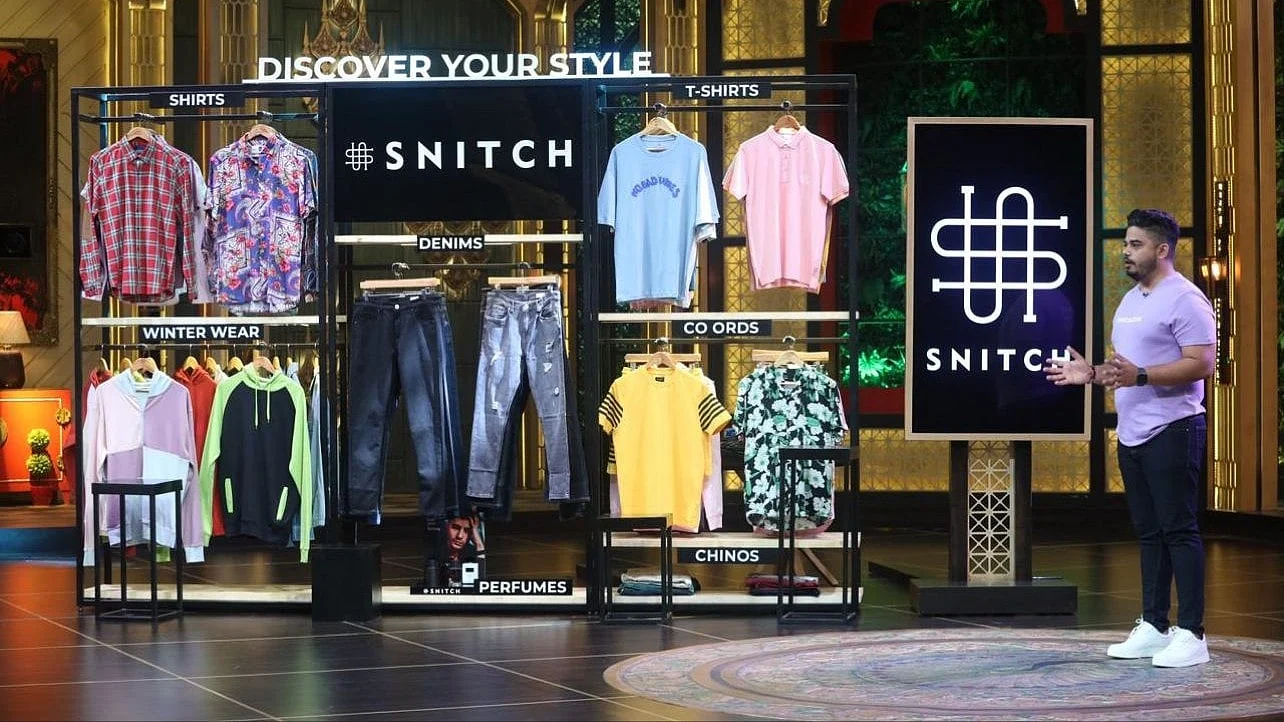
Snitch was founded by Siddharth Ramesh Dungarwal and is headquartered in Bengaluru. The founding year is reported as both 2018 and 2019 — company databases list 2018, while Inc42 and YourStory date the launch to 2019. The likely explanation is that Dungarwal was already running an apparel manufacturing and retail operation before the D2C brand itself launched, so the two dates describe different things. We could not establish which the company treats as its founding. It sells men’s fast fashion — shirts, T-shirts, denim, co-ords, chinos, outerwear — at price points aimed at India’s urban under-30s, with the trend-cycle speed that implies. Most people first encountered it on Shark Tank India, which remains the single best-known thing about it.
The financial arc:
| FY25 | FY26 | |
|---|---|---|
| Revenue | ~Rs 505 crore | ~Rs 900 crore |
| Growth | roughly doubled | ~80% |
| Bottom line | net loss ~Rs 1.7 crore | profitable, ~2-3% EBITDA margin |
An EBITDA margin of 2-3% on Rs 900 crore is roughly Rs 18-27 crore. That is thin — a rounding error against a bad season of unsold inventory — but the direction is what matters after a loss-making year, and thin-and-positive is a different company from thin-and-negative when you are talking to public-market investors.
On funding, it raised about Rs 340 crore at a reported Rs 2,500 crore valuation, with 360 ONE Asset leading and IvyCap Ventures and SWC Global continuing, joined by the Ravi Modi family office — the family behind Manyavar, which is to say ethnic-wear money backing a Western-wear brand.
Dungarwal has said the company will prepare an IPO once net profit reaches around Rs 100 crore, within roughly three years.
Why the stores are the story
The interesting mechanic here is not that a D2C brand opened shops. Everyone does eventually, once online customer-acquisition costs stop being cheap. It is that Snitch appears to have made the stores do more than one job.
Its channel split runs roughly 60% online, 40% offline — but offline is the faster-growing half. And when the company launched 60-minute fashion delivery in Bengaluru, it fulfilled those orders from its existing retail stores, using them as hyperlocal warehouses.
That is the part worth noticing. A store that is also a fulfilment node changes the unit economics of both sides: the shop carries footfall revenue and absorbs same-day delivery without a separate dark-store network, while the online business gets an hour-long delivery promise it did not have to build a warehouse estate to make. It is the same logic that made quick commerce work in groceries, applied to a category where nobody had assumed it was needed.
Whether anyone genuinely needs a shirt in sixty minutes is a fair question. But it is a real differentiator against both the marketplaces, which cannot match it, and the international fast-fashion chains, which have the stores but not the app.
The obvious risk
Fast fashion at 80% growth and a 2-3% margin is a working-capital business wearing a technology company’s clothes. Growth is funded by inventory bought ahead of demand, in a category where taste changes quarterly and unsold stock is written down rather than sold. Every additional store adds fixed cost — rent and staff — against variable, trend-dependent revenue.
Going from 115 stores to 300 in a single year is a very fast build. That is the number to watch: if it slips, the honest reading is that the model works but the pace did not, which is a considerably better problem than the reverse.
There is also a category question nobody in Indian fast fashion has answered yet. Snitch competes on speed and price with Zara and H&M above it and marketplace private labels below, and the brands that win that squeeze historically win on supply chain rather than on design. The 60-minute experiment suggests Snitch knows this.
What we could not verify
The FY26 figures are company-reported and unaudited. The revenue, the 80% growth and specifically the 2-3% EBITDA margin come from the company and were described as unaudited in the reporting. Audited filings will be the check on them.
FY25 revenue is reported two ways. Around Rs 505 crore and around Rs 520 crore both appear in coverage of the same year, probably the difference between total and operating revenue. We have used the lower figure for the year-on-year comparison.
Sources disagree on the funding. Coverage of the same Series B variously describes it as $33 million, $40 million, Rs 279 crore and Rs 340 crore. We have used Rs 340 crore at a Rs 2,500 crore valuation as the most recent figure, but the round was reported at different sizes at different stages and should be treated as approximate.
Store counts move constantly. Figures between 55 and 115 appear across the last two years of coverage, and a “111th store” milestone was reported separately. Around 115 is the most recent count we found; it will be wrong within weeks.
Nothing about profit per store is public. Whether the newer stores match the economics of the earlier ones — the thing that decides whether 300 is a good idea — is not disclosed.
Why this is on our desk
Because the received wisdom about direct-to-consumer retail in India is being quietly reversed by the companies that succeeded at it, and the reversal is legible in Snitch’s numbers.
It is also a coverage-reach point we keep making. Snitch’s expansion is not into Mumbai and Delhi, which it already has; the current push is into eastern markets and smaller cities. That is where the growth is and where almost nobody is reporting from — the same gap that shows up when a national outlet covers a state capital and skips the district around it.
FAQ
What is Snitch?
An Indian men’s fast-fashion brand founded in Bengaluru in 2018 by Siddharth Dungarwal. It sells online and through more than 100 of its own stores across India, aimed largely at urban men under 30.
Is Snitch profitable?
It reported its first profitable year in FY26, at an unaudited EBITDA margin of about 2-3% of roughly Rs 900 crore of revenue — approximately Rs 18-27 crore. That follows a net loss of about Rs 1.7 crore in FY25. The figures are company-reported and not yet audited.
How many stores does Snitch have?
Around 115 as of the most recent reporting, with a stated target of 300 by the end of 2026. The count changes frequently.
Is Snitch going to IPO?
Founder Siddharth Dungarwal has said the company will prepare for a listing once net profit reaches around Rs 100 crore, which he has framed as roughly three years out. No filing has been made.
How does Snitch deliver fashion in 60 minutes?
By fulfilling orders from its existing retail stores rather than from separate warehouses, so shops act as hyperlocal fulfilment hubs. It launched the service in Bengaluru.
Sources
Checked on 22 August 2026. All financial figures are company-reported and, for FY26, unaudited.
- Snitch — the storefront, categories and positioning: <https://www.snitch.com/>
- Outlook Business — FY26 revenue, growth rate, profitability and EBITDA margin: <https://www.outlookbusiness.com/corporate/snitch-fy26-revenue-jumps-80-to-900-cr-brand-hits-profitability>
- Outlook Business — the Rs 340 crore round and Rs 2,500 crore valuation: <https://www.outlookbusiness.com/start-up/investors/snitch-raises-340-cr-funding-valuation-jumps-to-2500-crore-to-fuel-expansion>
- Inc42 — corroborating FY26 revenue coverage: <https://inc42.com/buzz/d2c-brand-snitchs-fy26-revenue-surges-80-to-%E2%82%B9900-cr/>
- FashionNetwork India — revenue target and store-launch plans: <https://in.fashionnetwork.com/news/Snitch-eyes-rs-1-000-crore-revenue-in-fy26-plans-75-store-launches,1692092.html>
- Indian Retailer — the 60-minute delivery launch and store-as-fulfilment-hub model: <https://www.indianretailer.com/news/snitch-introduces-60-minute-fashion-delivery-redefines-quick-commerce-india>
Snitch was not contacted before publication and has not commented. If the company wants to correct any figure, including the audited FY26 accounts when they are filed, we will update this page.