This story is about Wispr. InSnaps has no commercial relationship with them.
In short: Wispr raised $280 million at a $2 billion valuation on 17 August 2026 for a dictation app that began life as scaffolding for the neural wristband it spent its first three years failing to ship.
- What it is
- Wispr Flow, a dictation tool that turns speech into cleaned-up text inside any application on Mac, Windows, iPhone and Android
- Founders
- Tanay Kothari (CEO) and Sahaj Garg (CTO), who met in a Stanford freshman dormitory
- Founded
- 2021, in San Francisco
- The original product
- A non-invasive neural and EMG wristband for silent speech, pitched in 2021 as a "thought-powered neural interface"
- The pivot
- Mid-2024. The dictation software had been built as test scaffolding for the wristband and became the product
- Series B
- $280 million led by Menlo Ventures, announced 17 August 2026, at a $2 billion post-money valuation
- Total raised
- $361 million across seed, Series A, an extension and the Series B
- Pricing
- Free tier at 2,000 words a week on desktop; Pro at $15 a month, or $12 a month billed annually
- Canto
- A new in-house speech model the company says cuts word error rates from over 30% to between 5 and 10% in noisy conditions. Previewed, not shipped, and not independently benchmarked
- Revenue
- Never disclosed. No ARR figure has ever been published, and circulating numbers are third-party estimates
- Verification status
- Funding and product history are well sourced; traction figures are self-reported and do not reconcile across outlets
On 17 August 2026, Wispr announced a $280 million Series B led by Menlo Ventures at a $2 billion post-money valuation, taking the company to $361 million raised.
The product that valuation is attached to did not exist when the company was founded, and was not what anyone invested in. It was internal tooling.
What Wispr was supposed to be
Wispr was founded in 2021 by Tanay Kothari and Sahaj Garg, who met in a freshman dormitory at Stanford. Kothari, born in Delhi, did a computer science degree and a master’s in AI at Stanford, and taught the university’s deep learning course alongside Andrew Ng. Garg is the CTO.
The company they raised money for was a hardware company. Its $4.6 million seed, from NEA and 8VC, was announced in a press release describing a ”thought-powered neural interface”: a non-invasive wristband reading neuromuscular signals so that a person could mouth words without vocalising them and have text appear. Silent speech. Among the angels was Josh Duyan, a co-founder of CTRL-labs — the neural-interface company Meta bought — which tells you the seed was underwritten by people who understood exactly what was being attempted.
It did not work. Over roughly three years the founders concluded that the models, the hardware miniaturisation, the regulatory path and user trust were all not there. By mid-2024 they had stopped.
The scaffolding
To test whether a silent-speech wristband produced usable text, you need software that takes a speech signal and writes it into whatever application the user is in. Wispr built that as internal test apparatus for the hardware.
When the wristband was abandoned, the apparatus was the only thing left that worked. They shipped it. It went to number one on Product Hunt for the day and the week within about six weeks, and then rolled out across platforms: Mac in October 2024, Windows in March 2025, iPhone in June 2025, Android in February 2026.
The funding history after the pivot tells its own story:
| Date | Round | Amount | Cumulative | Lead |
|---|---|---|---|---|
| Nov 2021 | Seed | $4.6M | $4.6M | NEA and 8VC |
| ~Oct 2022 | Seed II, debt and equity | — | $14.6M | Neo, MVP, TriplePoint |
| Jun 2025 | Series A | $30M | $56M | Menlo Ventures |
| Nov 2025 | Series A extension | $25M | $81M | Notable Capital |
| Aug 2026 | Series B | $280M | $361M | Menlo Ventures |
Three and a half years to raise $14.6 million for the hardware. Fourteen months after shipping the software, $347 million more.
What it actually does
Wispr Flow transcribes speech into any text field, and the interesting part is not the transcription. It strips filler words, resolves mid-sentence corrections, formats automatically, matches tone to the application it is typing into, and learns names and jargon specific to the user. That post-processing layer — not raw speech recognition — is what people describe when they say it feels different from dictation they have used before.
Pricing is free for 2,000 words a week on desktop, or $15 a month for Pro, $12 billed annually. It covers 100-plus languages across Mac, Windows, iPhone and Android. In August 2026 the company added a Notetaker for meetings, currently Mac-only, and opened an Advanced Interfaces Lab under Ariya Rastrow, previously of Amazon Alexa.
And the hardware has come back in through the side door. Wispr is now partnered with Oasis Devices, whose ring carries a microphone tuned for whispering and a trackpad on the finger. Having failed to build a wearable that reads speech you do not voice, the company is now attached to one that hears speech you barely voice.
The number the company chose to publish
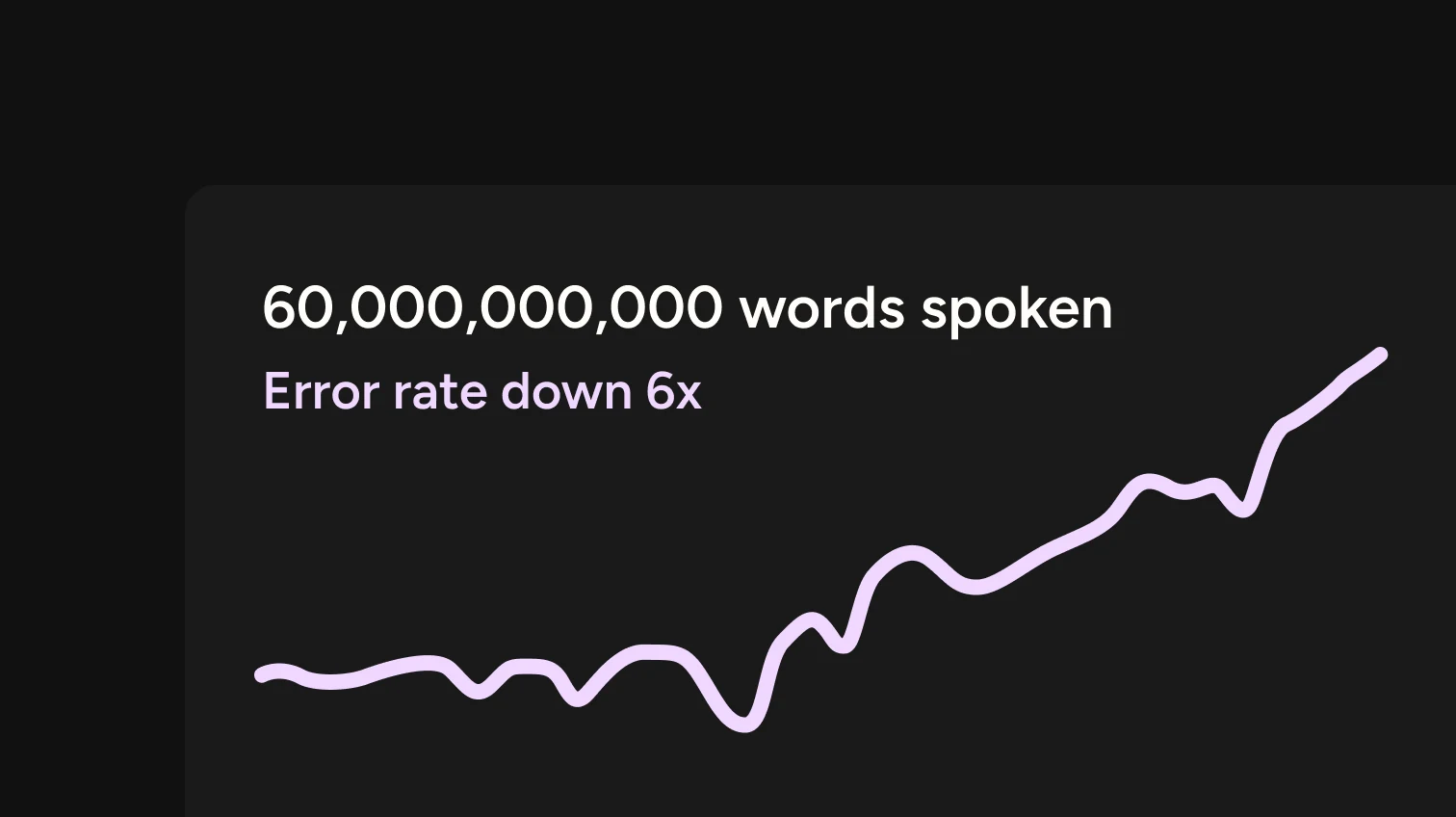
Alongside the round, Wispr previewed Canto, its first in-house speech model. The claim is that it cuts word error rates from more than 30% of words to between 5 and 10% in harsh or noisy conditions, and reduces user edits by 30 to 35%.
Read that again, because it is an unusual thing to announce. The company is saying that the product it has been selling — the one that just raised at $2 billion — misses more than three words in ten when conditions are bad. A four-fold accuracy improvement is good news about the future and a fairly stark disclosure about the present.
Canto was previewed rather than shipped, and there is no independent benchmark of it. Which matters more given the competitive picture: on the Open ASR Leaderboard in October 2025, Aqua Voice’s Avalon model posted a 6.24% average word error rate — sixth overall, first among proprietary systems. A much smaller rival is already at or ahead of what Canto has only promised.
Where the scepticism sits
On the valuation. The most useful quote in the coverage comes from Michael Ashley Schulman of Cerity Partners, speaking to The Next Web: ”Triple digit quarterly growth off a small base is the easiest number in venture capital to generate for a few quarters” — and the company, on his reading, is ”pricing a trajectory rather than a business.”
On the moat. Dictation is free and built into every operating system. Apple, Google, Microsoft, OpenAI and Anthropic are all adjacent, and Superwhisper, Aqua Voice, MacWhisper and others are directly competing. Menlo’s counter-argument is worth stating because it is the actual investment thesis: free dictation has existed for a decade with minimal adoption, because a feature can transcribe, but acting on intent takes a company. Whether that is a moat or a head start is the whole question.
On architecture. Flow is cloud-only. Every dictation is uploaded, with reported subprocessors including AWS, Baseten, OpenAI, Anthropic and Cerebras. Apple’s built-in dictation and Superwhisper can both run entirely on-device. For anyone dictating anything confidential, that is a real difference, and it is the trade the product makes for its quality.
On the product as it stands. TechCrunch’s own coverage of the round notes users complaining of recent declines in quality. Reported resource use is around 800MB of memory even when idle. Trustpilot sits near 2.7 out of 5.
What we could not verify
No revenue figure exists. Wispr has never published an ARR. Every number in circulation — figures around $10 million, or ranges of $15 to $35 million — is a third-party estimate derived from guessed subscriber counts. The company says revenue grew more than 150% for four consecutive quarters, which is a rate without a base.
The customer counts do not reconcile. Fortune reported 100,000 businesses; Menlo said “tens of thousands of paying businesses”; Reuters said more than 10,000 enterprises. These are not the same claim, and we cannot say which is right.
The 220 words-per-minute figure is marketing. It is the top of a company-quoted 150-to-220 range, benchmarked against average typing speed rather than measured against competitors. Independent reviewers have recorded roughly 98 to 184.
Headcount is unclear — somewhere between about 60 and 100, with a company database listing 94 in May 2026. Wispr has not published a figure.
A privacy incident is reported but thinly sourced. Smaller outlets reported that in May 2026 a user monitoring network traffic found Flow capturing periodic screenshots of the active window and uploading them as part of “context awareness”, that the user who disclosed it was banned, and that the CTO later apologised for the ban, after which training-data use moved from opt-out to opt-in. We could not find corroboration in any major publication, and the outlets carrying it are competitor-adjacent. We are noting it as reported and unconfirmed rather than as fact. Wikipedia’s article does separately note that the application can read device keystrokes.
Wispr’s own press materials are out of date. Its media kit still describes $56 million raised, which predates both the November 2025 extension and this round.
Why this is on our desk
Because the honest version of this story is not “founders had a vision and executed it.” It is that a hardware company failed for three years, and the instrument it built to measure its own failure turned out to be the product. That happens more often than founder mythology admits, and it is usually written out of the narrative afterwards.
It is also worth noticing what got funded. The wristband was the ambitious idea and raised $14.6 million over three and a half years. The unglamorous utility that types what you say raised $347 million in fourteen months.
FAQ
What is Wispr Flow?
A dictation tool that converts speech into cleaned-up text inside any application on Mac, Windows, iPhone and Android. It removes filler words, fixes mid-sentence corrections, formats text and adapts to the user’s vocabulary, which is what distinguishes it from standard operating-system dictation.
How much has Wispr raised and what is it worth?
$361 million in total. The most recent round was a $280 million Series B led by Menlo Ventures, announced on 17 August 2026 at a $2 billion post-money valuation. Earlier rounds were a $4.6 million seed from NEA and 8VC in 2021, a $30 million Series A led by Menlo in June 2025, and a $25 million extension led by Notable Capital in November 2025.
Who founded Wispr?
Tanay Kothari, the CEO, and Sahaj Garg, the CTO. They met in a Stanford freshman dormitory. Kothari was born in Delhi and studied computer science and AI at Stanford, where he also taught the deep learning course.
Did Wispr always make dictation software?
No. It was founded in 2021 to build a non-invasive neural and EMG wristband for silent speech — mouthing words without vocalising them. The dictation software was built as test scaffolding for that hardware. The company abandoned the wristband around mid-2024 and shipped the scaffolding instead.
What does Wispr Flow cost?
There is a free tier of 2,000 words a week on desktop and 1,000 on iPhone, with Android unlimited. Pro is $15 per user per month, or $12 per month billed annually. Enterprise pricing is custom and adds SSO, audit logs and a HIPAA-ready agreement.
How accurate is Wispr Flow?
The company has not published an independently verified accuracy figure. Its announcement of the Canto model implies the current product misses more than 30% of words in harsh conditions, which Canto is claimed to cut to between 5 and 10%. Canto was previewed rather than shipped and has not been independently benchmarked.
Sources
Checked on 22 August 2026. Funding and product-history facts are drawn from press coverage and the company’s own publications; traction figures are the company’s own unless stated.
- Wispr Flow — product, platforms and positioning: <https://wisprflow.ai/>
- Wispr Flow pricing — tiers, free-tier limits and enterprise features: <https://wisprflow.ai/pricing>
- TechCrunch — the $280 million Series B, valuation, total raised, Canto, Notetaker and the Oasis partnership: <https://techcrunch.com/2026/08/17/wispr-raises-280m-at-2b-valuation-as-it-looks-beyond-dictation/>
- Fortune — the round and the company’s growth claims: <https://fortune.com/2026/08/17/wispr-2-billion-valuation-dictations-only-the-beginning/>
- PR Newswire, 2021 — the original seed round and the “thought-powered neural interface” framing: <https://www.prnewswire.com/news-releases/wispr-ai-secures-4-6m-from-nea-and-8vc-to-build-thought-powered-neural-interface-301433912.html>
- TechCrunch, June 2025 — the Series A and the pivot to dictation: <https://techcrunch.com/2025/06/24/wispr-flow-raises-30m-from-menlo-ventures-for-its-ai-powered-dictation-app/>
- The Next Web — the sceptical read on the valuation and the Canto disclosure: <https://thenextweb.com/news/wispr-series-b-280m-2bn-valuation-menlo-canto>
- Wikipedia, “Wispr Flow” — pivot timeline, platform release dates and language count: <https://en.wikipedia.org/wiki/Wispr_Flow>
- Business Today — Kothari’s background: <https://www.businesstoday.in/technology/story/who-is-tanay-kothari-the-indian-origin-founder-betting-on-a-voice-first-future-with-wispr-flow-517860-2026-02-25>
Wispr was not contacted before publication and has not commented. If the company will publish an ARR, reconcile its customer counts, or confirm or deny the reported screenshot-capture behaviour, we will update this page.